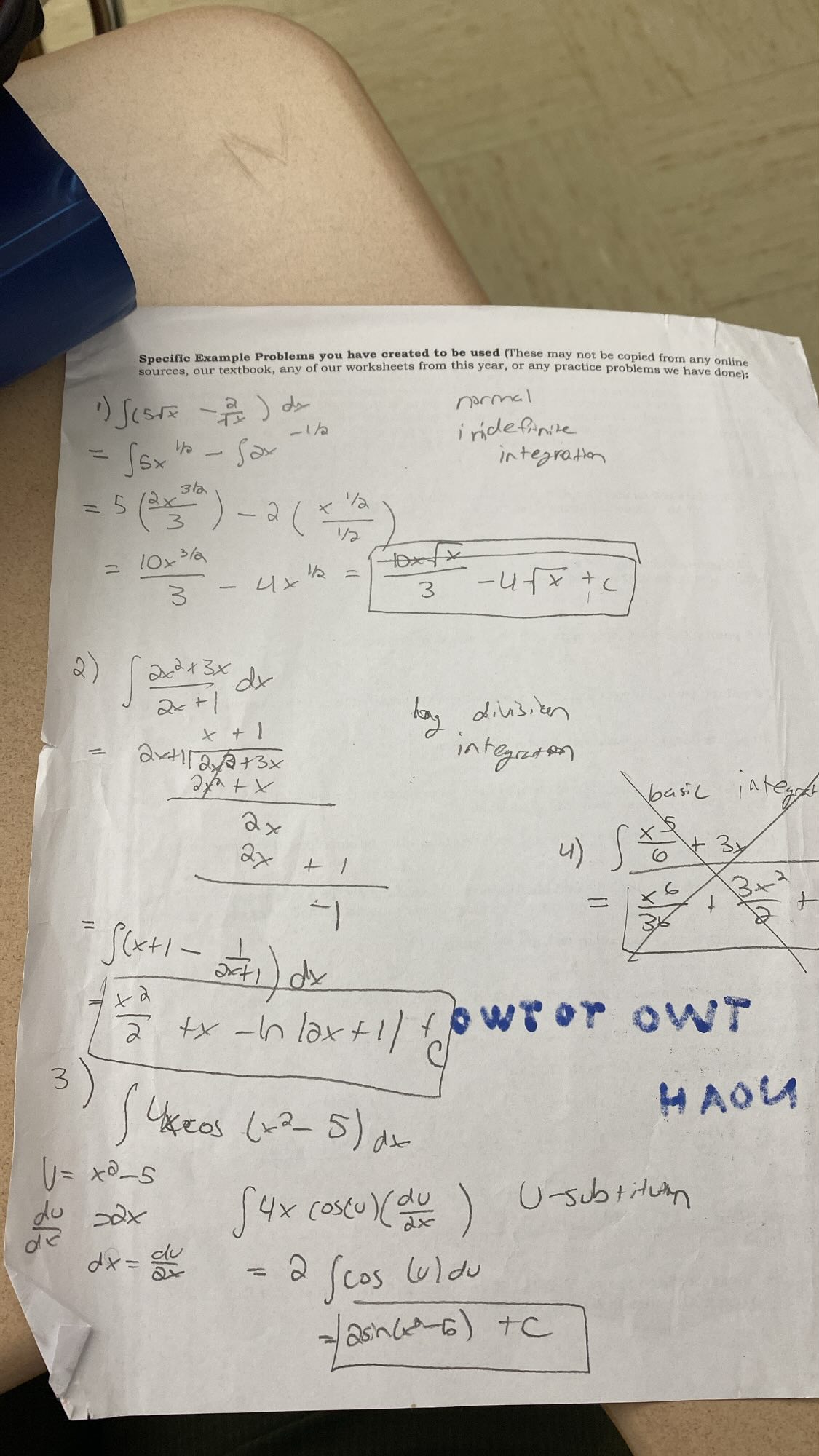
U-substitution is a method in calculus for simplifying the integration of a composite function by
substituting part of the integrand with a new variable u, making the integral easier to evaluate.
Steps:
Pick U, where U is a funtion inside the integral, that when differentiated, will simplify the integral
Differentiate U with respect to X
Integrate the outer function
Substitute U back into the function, with its true value
Add + C if it is indefinite, and compute with the Fundamental Theorem of Calculus if it is definite
Example:
Given the Integral ∫ 3xe^x^3dx
U = x^3
du = 3x dx
Outer Integral: ∫ e^u du
∫e^u du -> e^u + c
e^x^3 + c
Integration by Parts
Integration by parts is a technique in calculus used to integrate the product of two functions by applying
the formula ∫ u dv = uv - ∫ v du, where u and dv are differentiable functions of a
variable.
Steps:
Pick u (a function that simplifies when differentiated) and dv (the remaining part of the integral)
Differentiate u to find du
Integrate dv to find v
Use the integration by parts formula: ∫ u dv = uv - ∫ v du
Substitute into the formula
Add + C if it is indefinite, and compute with the Fundamental Theorem of Calculus if it is definite
Example:
Given the Integral ∫ x e^x dx
Pick u = x and dv = e^x
Differentiate: du = 1
Integrate: v = e^x
Integration by parts formula: ∫ x e^x = x e^x ∫ e^x 1
Simplify: x e^x - e^x + C
Final answer: x e^x - e^x + C
Relationship between Velocity, Acceleration, and Position
In calculus, there is a fundamental relationship between velocity, acceleration, and position.
Velocity is the derivative of position with respect to time, and acceleration is the derivative of velocity
with
respect to time. Integrating velocity with respect to time gives position, and integrating acceleration with
respect
to time gives velocity.
Steps:
Identify the relationship between position x(t) , velocity v(t) , and acceleration a(t) .
Recall that velocity is the derivative of position: v(t) = x(t) dt .
Recall that acceleration is the derivative of velocity: a(t) = v(t) dt .